Wednesday, December 9, 2009

Services We Provide our Customers

Located in the heart of Nashville, TN, our services incorporate anything from warehouse storage to running a complete distribution operation. Our experience ranges from management of raw materials and finished product inventory to line sequencing for Just in Time manufacturing facilities.

Here is a snapshot of distribution services we provide:
* Rail Access
* Asset Management
* Contract Warehousing
* Cross Dock Handling
* Customized Reporting
* Distribution
* Freight Consolidation
* Line Sequencing for Just in Time Manufacturing
* Pick & Pack

Click Here for a complete list of Distribution Services

Major Cities we service within Tennessee: Nashville, Knoxville, Memphis, Chattanooga
(including surrounding areas)

Monday, November 9, 2009

Outsourcing and respect

The idea of outsourcing often comes about when the CEO, controller, or another member of senior management reads an article—or has been speaking with a 3PL—about saving a minimum of 10 percent or more of their logistics costs by turning to a third party. However, I've found that these “savings opportunities” are often purely theoretical and are only supported by management due to their lack of logistics knowledge or their lack of confidence in the ability of its logistics team to efficiently manage its processes.


Of course, there are other times when the outsourcing conversation is sparked by the urgent need to reduce headcount.

The transportation teams that feel especially threatened are those that lack the experience, leadership, talent, knowledge, process excellence, and contingency strategies to guide their companies through today's global market. They often fail to anticipate and prepare themselves for tomorrow's challenges. And it often takes just one unpleasant and costly surprise to jumpstart the outsourcing movement in teams like these.

When I hear transportation leaders tell me that their companies keep reminding them that they're just another cost center, I tell them that it's their fault that management doesn't see them as a value-add to the organization. This tends to lead into the question: How do I get some respect?

The answer is simple. It's all about education and managing expectations—neither of which start in the middle of a crisis. Earning respect starts with your knowledge and command of the marketplace and your transportation governance, and it ends with programs that you have created to educate senior management and other organizations on a regular basis. As a quick reminder, I define transportation governance as “the direction and control associated with creation, administration, oversight, and enforcement of your company and supply chain's policies, regulations, and procedures related to the legal, safe, efficient, and service-effective movement of freight it controls either directly or indirectly.”

Transportation governance has both direct and indirect aspects. Direct governance includes: your carrier criteria and operating protocol/guidelines; selection and management of your carrier base; carrier due diligence evaluations, contract models and supporting documents; process with defined/flows/inputs-outputs; metrics and measures and dashboards; carrier performance reviews and process improvements; a carrier council to streamline processes and improve carrier and company productivity; greenfield projects and process improvements; and, of course, audits and benchmarking. Indirect governance, on the other hand, includes your command of the transportation industry including regulatory and political issues as well as a comparison of your approach to industry challenges versus that of your peers.

Read the rest of the logisticsmgmt.com article here.

Tuesday, October 13, 2009

New Study Highlights Role of Third-Party Logistics Providers in Helping Shippers Adapt to Economic Challenges

The fourteenth Annual Third Party Logistics (3PL) Study examining the current global market for logistics outsourcing was recently released. The study surveyed shippers and logistics service providers in North America, Europe, Asia Pacific and Latin America. Key findings included:

* The economic downturn has created significant challenges for both shippers and third-party logistics providers (3PLs) – 82% of shippers are employing cost-cutting tactics and 60% are rethinking their supply chains and relationships with 3PLs
* 88% of shippers feel that IT-based logistics services are important, but only 42% are satisfied with the capabilities of their provider – as a result of this IT capability gap, shipper respondents reported a lack of the key performance indicators, alerts and visibility required for an adaptive supply chain and 3PLs reported similar difficulties in getting the data and commitment they need from shippers
* There are significant differences between how 3PLs evaluate their role in the supply chain and how they are viewed by shippers – 59% of shippers feel their use of 3PLs has a positive effect on customer service compared to 88% of 3PL respondents
* Shipper respondents devote an average of between 47% (in North America) and 66% (in Europe) of their total logistics expenditures to outsourcing and this is expected to increase in the next five years.

“Shipper-3PL relationships are being impacted significantly by the prevailing uncertainty and economic volatility in global markets,” said Dr. C. John Langley Jr., Professor of Supply Chain Management, Georgia Institute of Technology. “It is very important for 3PLs to mitigate or reduce any financial risk or service level impact that this may cause.”

Economic uncertainty and the use of 3PLs
Economic volatility has challenged shippers and 3PLs alike to contend with factors such as unpredictable demand, instability in fuel costs and currency valuation, and excess inventory. In response, not only are shippers attempting to cut costs, 77% are also seeking to improve forecasting and inventory management.

Cost reduction and improved reliability in services are the main factors likely to increase shipper respondents’ use of 3PLs. This includes converting fixed to variable costs (59%), expanding to new markets or offering new products (56%), and restructuring the supply chain network to improve financial performance (48%).

Supply chain orchestration
The study shows that while shippers continue to outsource logistics services that are more operational and repetitive, they outsource less frequently those that are more strategic, customer facing and IT intensive. However, economic volatility presents an opportunity for shippers to assess their supply chains and make changes designed to increase agility and responsiveness, reduce costs and reconsider their relationships with 3PLs to drive them deeper. Overall, 75% of shipper respondents agree that more strategic 3PL relationships would help them reduce costs.

In order to achieve a more strategic shipper-3PL relationship, shippers want to see 3PLs investing in enhancing their regional and vertical expertise to better understand their particular business. Shipper respondents will also need to be more forthcoming with their data and be willing to team with 3PLs to re-engineer business processes.

Read the rest of the mhia.org article here.

Thursday, September 10, 2009

Logistics and business news: Signs are afloat that freight economy is slowly recovering

Some recent economic indicators point to the possibility of the recession coming to an end, but before that is made official, more needs to happen, according to freight transportation and logistics experts.

In the last two weeks there have been an abundance of signs signifying positive economic activity. Some examples include:

· the Institute of Supply Management’s manufacturing index—the PMI—which covers the overall health of the manufacturing sector, rose four percentage points to 52.9 percent, marking the first time the index has climbed above 50 since the recession began—the 50 percent mark is typically viewed as the dividing line between “growth” and “contraction”;

· the Department of Commerce’s recent report that durable goods orders were up by its largest amount in two years, with a 4.9 percent bump, that has seen the increase up in three of the last four months;

· the Cass Information Systems Freight Index, which measures freight expenditures and payables, was up 1.3 percent in August compared to July.

Although these signs are encouraging, it by no means reflects a healthy and prosperous economy or freight transportation market. And they can easily be quelled by some less-than-rosy indicators, including: sluggish back-to-school retail sales, which typically signal increased consumer spending activity; improving but still down truck and railroad volumes; and low import totals at various U.S.-based ports, among others.

While the overall economic picture is blurred, one industry analyst told LM there are some things to be optimistic about

“In general, things are positive, especially the ISM index which suggests manufacturing is picking back up,” said Eric Starks, president of freight transportation forecasting firm FTR Associates. “We have been looking for stabilization in the economy and have seen things stabilize in the last three months as the economy has hit the bottom.”

Starks added there are a lot of “positives” out there, with evidence that things may have slowly started to turn the corner. But he cautioned that it is premature to determine if enough has happened, adding that the dent the recession had made in the economy requires a lot to happen over the next six-to-nine months, as well as the fact that recent positive economic signs have yet to translate into a rebound in freight demand.

Stifel Nicolaus analyst John Larkin commented that some of the sequential uptick occurring with freight volumes portends too much optimism at this point, explaining they are more seasonally-based and creating a “temporary hope” that things are better over September and October.

For things to truly improve, Larkin said, consumer spending needs to recover. But as things stand, consumers still face too many obstacles, such as high unemployment, increased savings to off-set lost funds due to wage cuts and the recession.

“Consumers are coming up on Labor Day and are still in the bunker waiting for the economy to feel better,” said Larkin.

Read the rest of the logisticsmgmt.com article here.

Thursday, August 13, 2009

Why 3PLs need to build their brand

Over the past several years, the global third party logistics (3PL) industry has changed dramatically. While the demand for 3PL services has grown steadily, the major logistics service providers have expanded their geographical reach and broadened their service offerings. At the same time, the structure of the industry has changed not only through mergers and acquisitions, but also through new market entry by many companies, including some funded by private equity investors. 3PL company reorganizations and name changes have become commonplace.

These changes have fostered a degree of buyer confusion in the marketplace, and many large 3PLs fear a possible “commoditization” of their services in the eyes of those who currently buy their services or are considering doing so. If this is indeed occurring, existing and potential customers will become increasingly indifferent when choosing between logistics service providers. And this, in turn, will intensify the price compression pressures that already plague the 3PL industry.

A key question that needs to be asked here is: What are executives of those 3PL companies doing in response to these market developments? Specifically, what steps have large 3PLs taken in recent years to differentiate their service offerings in the marketplace while strengthening their brands? Further, is there more that those executives should be doing in those areas?

This article addresses the typical steps that companies should take in building, refining, and strengthening their brands—and in particular examines recent attempts by major 3PLs to do so. Branding literature forms the basis for discussion of the general case, and the branding steps taken by large 3PLs were documented through data generated during 2006 and 2007 in surveys of the CEOs of major 3PLs operating in three geographic regions: North America, Europe, and the Asia-Pacific region. (For more on the surveys, see accompanying sidebar). We conclude with suggestions for 3PL industry executives concerning their future branding efforts—and the potential positive implications of these efforts on the buyers of these services.

Read the rest of the article here.

Tuesday, July 14, 2009

ISM: Non-Manufacturing Continues Upward Climb

It is highly likely that signs of growth and possibly economic recovery will be visible by the end of this year, according to the results of the latest non-manufacturing industry survey by the Institute for Supply Management (ISM).

The ISM has been making such a prediction for some time now, and the report on business activity in the non-manufacturing sector in June indicate the economy is definitely headed in that direction, said Anthony Nieves, chair of ISM’s non-manufacturing business survey committee.

“The report is encouraging,” he said.

Overall, the non-manufacturing index went up three percentage points in June to 44 percent. Technically, anything under 50 percent is considered to be “contracting,” but Nieves said the trend over the last few months has been a positive one, indicating that the index is creeping steadily upward, indicating a gradual improvement in the overall non-manufacturing sector.

“I think we’re seeing the signs of the leveling off,” he said.

Nieves said he was especially encouraged by the business activity and new orders indexes. Business activity leapt up 7.4 percentage points to 49.8 percent, while new orders went up 4.2 points to 48.6 percent.

Nieves said he will be watching both indices over the next few months, especially new orders, to verify that the growth trend overall is continuing.

The employment index, which typically lags behind everything else, also took a jump in June. According to the report, it went up 4.4 points to 43.4 percent, but despite this increase, Nieves said employment tends to be the slowest to react to changes, even positive ones, in the overall sector.

“I think you’ll see the other indexes go up to 50 and above before employment,” he said.

The report shows that the real estate, rental and leasing category leads in growth, but Nieves said that was a bit misleading, since most of the recorded growth in that category was only in the rental and leasing side.

More encouraging, he said, was food services and arts, entertainment and recreation, which also showed growth in June. Nieves said these industries will be the ones to watch over the next few months.

Right now, ISM predicts that both manufacturing and non-manufacturing sectors will be showing positive numbers before the end of 2009, with potential for growth and recovery in early to mid 2010. So far, Nieves said, the current figures show the economy moving in the direction of the ISM predictions.
Monday, June 8, 2009

Transportation funding: Highway Trust Fund is again in need of more capital

A lack of capital for the Highway Trust Fund (HTF) is looming, with up to $7 billion to required keep it solvent through the remainder of 2009, according to various reports.


The HTF is the federal government’s primary source for financing highway, bridge, and transit projects, and it is largely funded by the motor fuel federal tax, which is 18.4 cents per gallon for gasoline and 24.4 cents for diesel and has not been raised since 1993. One main reason for the HTF’s dwindling financial resources is that Americans are driving fewer miles, as evidenced by Americans driving 90 million fewer miles year-over-year in fiscal 2008.


California Senator Barbara Boxer said at a hearing yesterday that the HTF is estimated to have insufficient cash by August 2009 to make good on prior commitments, with $5-to-$7 billion needed.


She added that White House officials have estimated that an additional $8-to$10 billion is needed to pay immediate

cash needs of the HTF program is to be maintained at current funding levels through the end of fiscal 2010, which is when Safe, Accountable, Flexible, Efficient Transportation Equity Act: A Legacy for Users (SAFETEA-LU), the current highway, transit, and highway safety authorization, expires.


“The administration is working closely with Congress to solve this difficult problem and ensure that states have the resources they need to maintain our roads and highways,” Department of Transportation Spokeswoman Jill Zuckman told the Associated Press.


Read the rest of the logisticsmgmt.com article here.

Monday, May 11, 2009

Transportation infrastructure: Leaked copy of Oberstar transportation bill offers clues to new vision for transportation policy

Jeff Berman, Group News Editor -- Logistics Management, 5/11/2009

WASHINGTON—With the highway re-authorization bill—Safe, Accountable, Flexible, Efficient Transportation Equity Act: A Legacy for Users (SAFETEA-LU)—set to expire at the end of September, various freight transportation industry stakeholders are keeping an eye on the next version of the bill.

And earlier today a report from BNA, a publisher of legislative, regulatory, and economic news publisher, provided a look at some of the main takeaways of a new version of the bill from James L. Oberstar, Chairman of the House Transportation and Infrastructure Committee. Some of the highlights of the bill, which many industry observers have said could require more than $500 billion (compared to the current one of $286 billion), are listed below:

  • a call for a change in “transit equity” that would differ from the current set-up in which the federal government pays for 80 percent of highway projects and 50 percent of transit projects, which Oberstar said would “level decision-making factors between highway and transit choices/projects.”;
  • a consolidation of the Department of Transportation’s 108 programs into four major programs—critical asset preservation, highway safety improvement, surface transportation program, and congestion mitigation and air quality improvement; and
  • create a new undersecretary or assistant secretary for intermodalism that would meet monthly with all modal administrators, among others.
Read the rest of the article at logisticsmgmt.com here.

Tuesday, April 14, 2009

About M&W Logistics Group

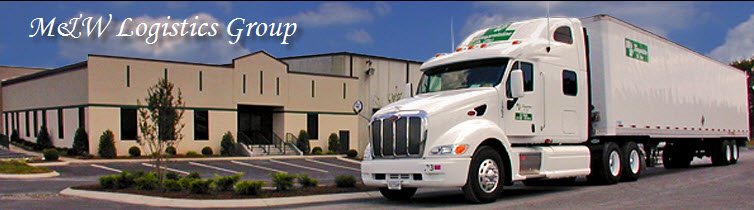
The M&W Logistics Group, an asset based third-party logistics company in Nashville, TN, provides a full range of logistical solutions including, but not limited to: asset based truckload transportation, dedicated fleet service, warehousing and distribution and logistics management.

M&W Logistics Group’s history began in 1973 when Jim McFarlin launched Consolidated Cartage. In 1975, Mr. McFarlin was inspired to enter the warehousing and distribution industry, so he purchased Nashville Warehousing Company, Inc. As the trucking industry changed in the early 80’s, so did customers’ needs. In 1983, Consolidated Cartage changed from a cartage company to a truckload carrier known as M&W Transportation Company, Inc.  As we continue to grow, we continuously put into operation additional services to encompass all of our customers’ logistical needs.

Contact M&W Logistics today to see how we can better serve you.